
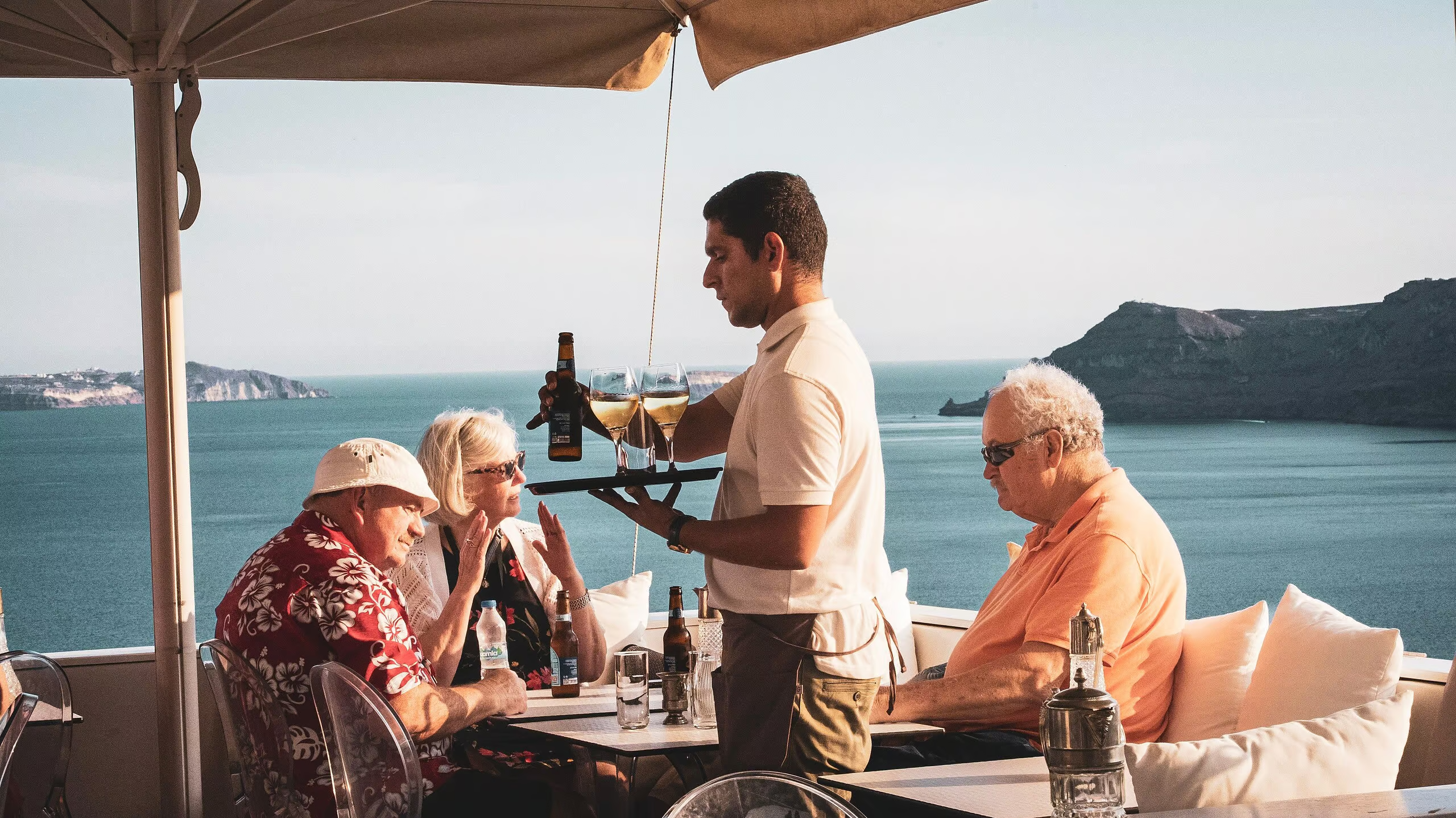
The Albania tourism season 2026 is shaping up to be the most significant in the country’s history. Visitor arrivals have grown from 3.8 million in 2014 to nearly 12 million in 2024, and 2026 is projecting further growth on the back of expanded European flight connections, growing social media visibility, and Albania’s emergence as one of the Mediterranean’s most discussed undiscovered destinations. Tourism now represents more than 20% of Albania’s GDP, and the summer season determines the financial year for thousands of businesses along the coast and in Tirana.
The problem is sitting right next to this opportunity. More than 6,000 tourism vacancies remain unfilled nationwide. Tourism expert Feriolt Ozuni warns the industry needs 35% more staff to meet demand — without them, service quality risks declining precisely at the moment Albania is gaining serious international attention.
For businesses that have solved this staffing problem — including those that moved to international recruitment — the 2026 season is a significant commercial opportunity. For those still operating on a depleted local workforce, the same season is producing a different outcome: slow service, overwhelmed staff, poor reviews, and customers who came once and will not return.
The divergence between these two groups of businesses is the defining story of the Albania tourism season 2026.
Albania Has More Tourists Than Its Workforce Can Serve
The numbers tell a straightforward story. Albania’s population has shrunk from 2.9 million to approximately 2.4 million over the past decade, driven by sustained emigration of young, educated workers — the exact demographic the hospitality industry depends on most during peak season.
The tourism sector tried to bring back staff following the recovery of European tourism after the pandemic, but many had already found jobs in other sectors or moved abroad, leading to reduced service capacity. The chairman of the Albanian Tourism Operators Association described the situation: “We invested a lot in training our staff on the job over the last five to ten years. Yet we were forced to let them go — first the younger staff and then the more experienced ones.”
The result is an industry that has been adding capacity — new hotels, new beach clubs, new restaurants along the Riviera — without proportionally adding the staff to operate that capacity at the level modern international tourists expect. Across Albania’s coast, “help wanted” signs now hang just as prominently as menus.
Many local candidates prefer stable, year-round employment, while hospitality employers need a workforce that can scale up and down without sacrificing service quality — creating a structural mismatch that local recruitment alone cannot resolve. The Albania tourism season 2026 has made this mismatch more visible and more consequential than any previous year.
What Understaffing Actually Does to a Tourism Business
The impact of running the Albania tourism season 2026 without adequate staff is not theoretical. It plays out in specific, measurable ways that affect revenue, reputation, and long-term customer value.
Service speed collapses under peak load. A restaurant with three front-of-house staff instead of six does not serve the same number of tables at the same speed. It serves fewer tables, with longer wait times, at higher stress for the staff remaining. Guests who waited forty minutes for their order at a coastal restaurant in August will not attribute the problem to Albania’s labor market — they will write a two-star Google review and tell their friends the place wasn’t worth it.
Staff burnout accelerates mid-season. When a team of twelve is doing the work of twenty, the first casualty is energy and then it is quality. By the third week of August — the peak of the Albania tourism season 2026 — the overworked staff at understaffed businesses are visibly running on empty. Guests notice. The warmth and attentiveness that distinguishes good hospitality from adequate hospitality disappears under unsustainable workloads.
Operational gaps force service cuts. Understaffed businesses make hard choices: rooms cleaned less thoroughly, fewer menu options available because the kitchen team can’t execute the full card, housekeeping done once a day instead of twice, the pool bar closed on weekdays because there’s no one to staff it. These are not catastrophic failures — they are the quiet, cumulative service erosions that distinguish a business that returns customers from one that doesn’t.
Tourism expert Gladiola Dona put the outcome clearly: “We satisfied curiosity, but didn’t give people a reason to return. We quenched their curiosity, and they left. We raised prices without basing them on what we were offering. If we fail to improve service, then we must lower prices. We’re competing with smarter markets in the region who base their prices on service and quality.”
The review record for the Albania tourism season is increasingly splitting along staffing lines. The businesses investing in reviews and return bookings are, without exception, the ones that have adequate teams. The ones accumulating critical comments about slow service and inattentive staff are the ones still waiting for the local market to solve a problem the local market structurally cannot solve.
What Foreign Staff Actually Delivers — and Why It Changes the Outcome
The businesses that have moved to international recruitment during the Albania tourism season 2026 are not doing so for ideological reasons. They are doing it because it works — and the evidence is visible in their operations.
From hotel personnel and restaurant teams to lifeguards and beach bar attendants, foreign workers keep the service levels that international travelers expect. Often stepping in where the shrinking local labor force cannot, they also bring fresh skills and perspectives that lift the country’s entire hospitality scene.
Foreign workers often bring specialized training and experience, particularly in hospitality. Filipino workers, for example, frequently have experience in luxury hotels and cruise ships, bringing high service standards to Albanian tourism. Latin American workers, experienced in global hospitality and often fluent in multiple languages, fit easily into guest-facing roles that cater to Albania’s mix of Western European visitors and diaspora travelers.
Klevis, a restaurant owner in Shëngjin, keeps two Filipino employees on staff year-round because he cannot find local replacements: “I can find a student for the summer, but a full-time cook or receptionist?” Each new beach bar or hotel that opens creates more positions, and finding enough Albanians to fill them is getting tougher every year.
The multilingual capacity of many international hospitality workers is particularly relevant in the Albania tourism season 2026. A team that includes Spanish, English, and Italian speakers serves the actual demographic of visitors Albania is attracting far more effectively than a monolingual local team. For guests who do not speak Albanian and whose experience depends on clear communication with staff, this difference is not a minor bonus — it is the difference between feeling welcomed and feeling managed.
Global workforce solutions help operators plan staffing in predictable seasonal cycles by building reliable candidate pipelines — people who understand seasonal work, arrive prepared, and when the experience is managed well, can return year after year. The return factor matters: a foreign worker who had a positive experience in the Albania tourism season and returns the following year brings existing operational knowledge, requires no re-training, and represents a meaningful reduction in the annual staffing cost per head.
The Competitive Gap Is Opening — and Widening
The Albania tourism season 2026 is creating a bifurcated market. On one side are the businesses that moved to international recruitment one or two seasons ago, have now built operational experience with foreign staff, have refined their onboarding and integration process, and are entering the 2026 season with full teams, stable rosters, and the capacity to deliver consistent service. On the other are the businesses that are still waiting — hoping the local market recovers, posting the same vacancies, losing the same candidates to competitors or emigration, and entering peak season understaffed again.
The gap between these two groups is not just operational. It is showing up in review scores, booking rates, and the ability to hold pricing. As Albania becomes more competitive as a tourism destination and attracts more international visitors, guests expect multilingual communication, consistent experiences across shifts, and quick problem-solving when issues arise. The businesses meeting those expectations are capturing the season. The ones not meeting them are absorbing the consequences in real time.
Albania is perceived as an interesting destination for a first visit, but not as a place one would want to return to every year — and the shortage of qualified staff is one of the primary causes. Being new and undiscovered is no longer enough. The time has come for a deep and professional transformation of the tourism industry.
That transformation is happening business by business. The ones leading it are the ones staffed to deliver it.
The Timeline Problem: Summer 2026 Starts Now
The most important practical point for any hospitality business reading this in the spring of 2026 is that the Albania tourism season does not wait for the recruitment process to complete. International hiring through a licensed partner takes six to eight weeks from initial engagement to workers arriving and starting. That timeline is fixed — it reflects visa processing, documentation, travel coordination, and onboarding preparation that cannot be meaningfully compressed.
A business that begins the international recruitment process in early May will have staff in place by mid-to-late June — which is adequate for a full summer season. A business that begins in July will have staff arriving in August, which covers the tail end of peak season and is better than nothing, but misses the highest-volume weeks. A business that doesn’t begin at all will manage the Albania tourism season 2026 with whatever local staff it can find — which, based on the structural labor market conditions, is not enough.
The time to act is now, before the season is already underway and the damage to service quality and reputation is compounding week by week.
How Fenix Consulting & Recruiting Staffs Albanian Tourism Businesses for the Season
Fenix Consulting & Recruiting is Albania’s licensed international recruitment partner for hospitality, tourism, food and beverage, and accommodation businesses preparing for the summer season. We source pre-vetted candidates from 11 countries — including the Philippines, Colombia, Mexico, Indonesia, Uganda, and Ukraine — with documented hospitality experience, English-language capability, and the reliability profile that a seasonal operation depends on.
Our international hospitality staffing service delivers candidates ready to start within 6 to 8 weeks of initial engagement. We manage the full work permit and visa process under license LN-0987-01-2026, coordinate arrival and onboarding logistics, and provide a replacement guarantee within the first three months of placement.
For businesses that need a workforce planning consultation before committing to international recruitment — to understand how many positions can realistically be filled locally, which roles benefit most from international candidates, and how to build a staffing structure that holds through peak season — our HR consulting team provides exactly that service.
Explore our global sourcing reach and the industries we serve, then na kontaktoni to begin the process. The Albania tourism season 2026 is already in motion. The businesses that are fully staffed for it started this conversation months ago. There is still time to be ready — but the window is narrowing.
Fenix Consulting & Recruiting — connecting Albanian hospitality businesses with reliable international staff for the 2026 season and beyond.